


HTCO AUSTRALIA PTY LTD
8/42 Hub Crescent,
Heathwood QLD
info@htco.com.au
0423 083 787

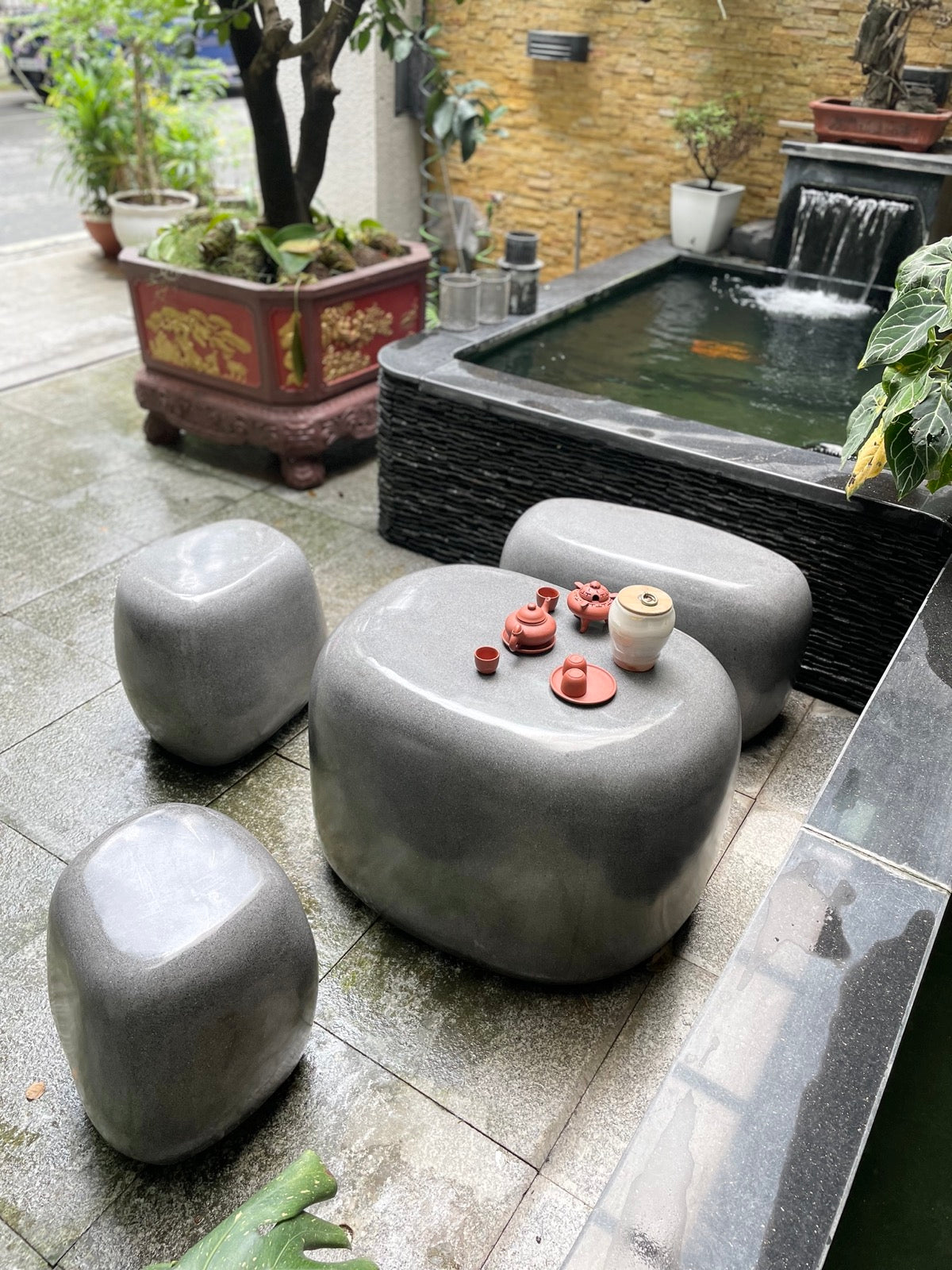
Terrazzo is one of the oldest surfaces in the world — offcuts of marble set into mortar, ground smooth, first laid underfoot in Venetian courtyards five hundred years ago. What we make at HTCO carries that same idea forward, but the material underneath it has changed completely. This is the story of how a single benchtop travels from a handful of raw chips to a finished, hand-polished surface.
Traditional terrazzo is heavy, and under tension it cracks. By replacing steel reinforcement with a fine mesh of alkali-resistant glass fibre, GFRC lets us cast pieces that are up to two-thirds thinner and dramatically lighter — a full-size vanity two people can carry, a benchtop that spans further without a support leg, a bathtub that a bathroom floor can actually take.
Thinner and lighter is not only about logistics. It changes what a designer can draw. Cantilevered basins, floating shelves, wrap-around bench returns and seamless splashbacks all become possible when the stone weighs a fraction of the solid-cast alternative.
Every batch is mixed by weight, poured by hand, and cured slowly. Nothing about it is fast — that is the point.
Before anything is poured, we build a colourway. Recycled glass, crushed marble, mother-of-pearl and mineral chips are weighed out in a dozen sizes — coarse pieces for drama, fine grit for depth — and blended with pigment into the wet mix. Two surfaces that share a name will never be identical; the scatter of chips is decided in the pour, and that is exactly why terrazzo feels alive rather than printed.
Once the colourway is set, the piece moves through four unhurried stages:
The result has real depth — light travels a little way into the glass and marble before it bounces back, which is why a terrazzo top never looks flat. Cared for simply, it does not wear out so much as soften into a patina, the way good stone always has. That is what we mean when we call it artwork.
Every HTCO piece is made to order in our factory, with no minimum quantity, and warehoused in Heathwood, Queensland for fast dispatch across Australia. If you would like to see and feel a sample colourway in person, get in touch — we are happy to send one out.
HTCO AUSTRALIA PTY LTD
8/42 Hub Crescent,
Heathwood QLD
info@htco.com.au
0423 083 787